How Far Should I Walk My Dog?
There is no single right answer, but there is a way to find yours: measure what you actually do, then watch how your dog responds to it.
By Tony Dalton · Updated
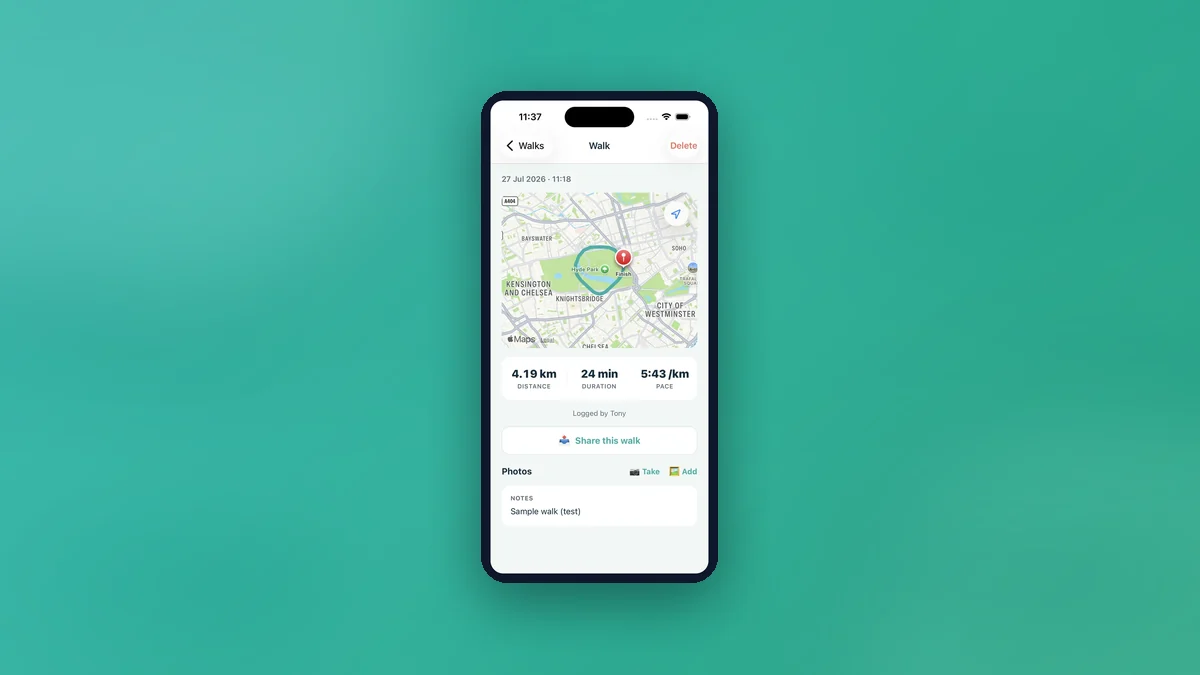
There is no universal figure, and anyone who gives you one is guessing. The right amount depends on breed, age, build, health, weather and the individual dog, and your vet is the right person to ask for a dog with any health considerations. What you can do is stop estimating: measure what you are actually doing now, and you will have something real to reason about.
Why estimates are always wrong
Ask most owners how far they walk their dog and you get a number that has never been checked. "About an hour" covers everything from a slow amble round the block to five miles across fields. "Twice a day" says nothing about distance. And in a household where two or three people share the walking, nobody knows the weekly total — everyone assumes the others are doing roughly what they are.
The result is that the two most common conversations about dog walking — is he getting enough, and is she getting too much for her age — happen without any data at all.
What measuring actually gives you
CorePaw's walk tracker records a live GPS route with distance, duration and pace. It uses a background location task with a foreground service, so tracking continues with the screen locked and the phone in your pocket — which matters, because a tracker you have to babysit is a tracker you stop using by week three.
Each saved walk keeps its route map, and per-pet history and totals build up without any effort on your part. After a fortnight you know your real numbers instead of your imagined ones, and they are usually a surprise in one direction or the other.
The factors worth thinking about
Rather than a distance table, the questions that actually matter:
- Age. Growing dogs and older dogs are both discussed differently from adults in their prime, and for a growing dog especially this is a conversation to have with your vet rather than to work out from the internet.
- Build and breed. A flat-faced dog, a very heavy dog and a working breed have little in common here.
- Weather. Heat is the one that causes real harm, and it changes the answer completely on a given day.
- Recovery. How the dog is that evening and the next morning tells you more than any figure.
- Type, not just distance. Sniffing, exploring and varied terrain are not interchangeable with pavement miles.
Watching the response, not just the number
The useful loop is: record the walk, then note how the dog was afterwards. CorePaw lets you add notes and photos to a walk, and if something is worth watching properly — a limp that shows up after long walks, a paw that gets sore on hot pavement — the symptom diary tracks it over time with dated photos, an optional measured size, and an active, monitoring or resolved status.
Pair that with weight and body condition tracked over months and you have the two things a vet will actually ask about.
When several people walk the dog
Multi-person households benefit most from measuring, because the total is invisible otherwise. Walks logged by any household member appear in the same per-pet history, stamped with who logged it. If you walk two dogs together, one shared walk is recorded against each dog, so each history is correct without walking them separately — see recording a walk with two dogs.
General information about tracking walks, not veterinary advice. Exercise for a puppy, an older dog or a dog with a health condition is a question for your vet.
Related articles
Keep your pet's whole record in CorePaw.
Passport, microchip, vaccinations, medications, walks and weight — working offline and shared with your household. Free for your first pet, on iPhone and Android.