Forgot to Start the Walk Tracker?
Half a walk logged, or none at all. Why tracking fails in practice, what to do about the walk you missed, and how to make the habit survive.
By Tony Dalton · Updated
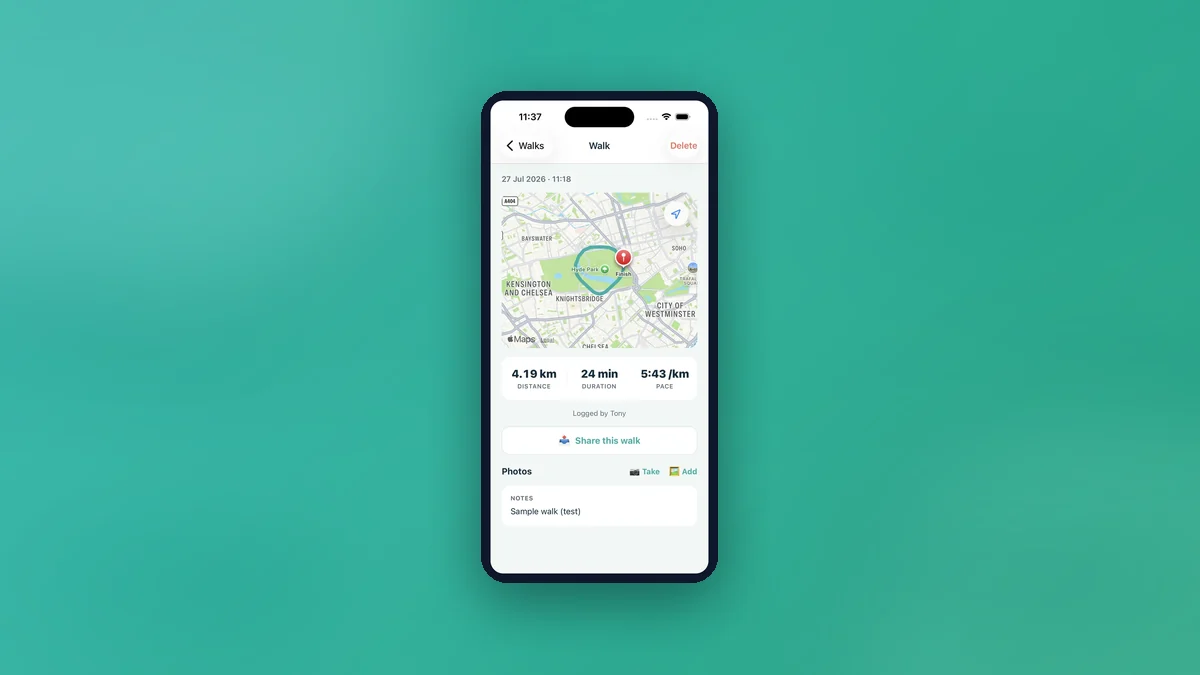
Add it manually. A walk entered afterwards with its distance and duration goes into the same history as a tracked one — it simply has no route map. A history with a gap in it is less useful than a history with an estimate in it, and this is the single most common reason walk tracking gets abandoned in the first month.
Why tracking fails in practice
The failure is rarely the app. It is that starting a walk competes with a lead, a harness, a poo bag, a door and a dog who has decided this is happening now. Anything requiring three taps at that moment loses.
Two design choices help. CorePaw puts a prominent Start walk button on the home screen rather than buried in a pet's profile, and shows a resume-walk banner if one is still running — which handles the other common failure, forgetting to stop.
The locked-screen problem
The other classic is a walk that records the first two hundred metres and then stops, because the phone locked or the app went to the background. CorePaw uses a background location task with a foreground service specifically so tracking survives a locked screen and a pocket. You are not meant to hold the phone for forty minutes.
If you are ever unsure whether it is still going, the resume banner is the tell.
What a manual walk is actually for
Manual entry is not a consolation prize. It exists because the value of the history is in its completeness, not in every entry having a map. If you are trying to answer "how much is she doing each week", a fortnight with four missing walks gives you the wrong answer with confidence.
Estimate honestly: a familiar route you have tracked before gives you a good distance, and duration you usually know within a few minutes. Mark it and move on.
Making the habit survive
A few things that help more than discipline does:
- Start it before the lead goes on, not after — the dog is calmer and your hands are free.
- Do not check it mid-walk. The pocket is the point.
- Fill gaps the same evening, while you still remember the route.
- Let others log too. In a shared household any member with walk access can log, and it lands in the same per-pet history stamped with who did it.
What the history is for
Once a few weeks accumulate, the per-pet history and totals stop being a novelty and start being evidence — for a conversation about weight, about a dog slowing down, about whether the arrangement with the walker is working. Combined with weight and body condition over the same period, it is the kind of thing a vet can actually use.
A record with honest estimates in it beats a perfect record with holes.
Related articles
Keep your pet's whole record in CorePaw.
Passport, microchip, vaccinations, medications, walks and weight — working offline and shared with your household. Free for your first pet, on iPhone and Android.