Keeping Track of Worming and Flea Treatment
Routine treatments are the easiest to lose track of precisely because they are routine. What to record, and why the product name matters.
By Tony Dalton · Updated
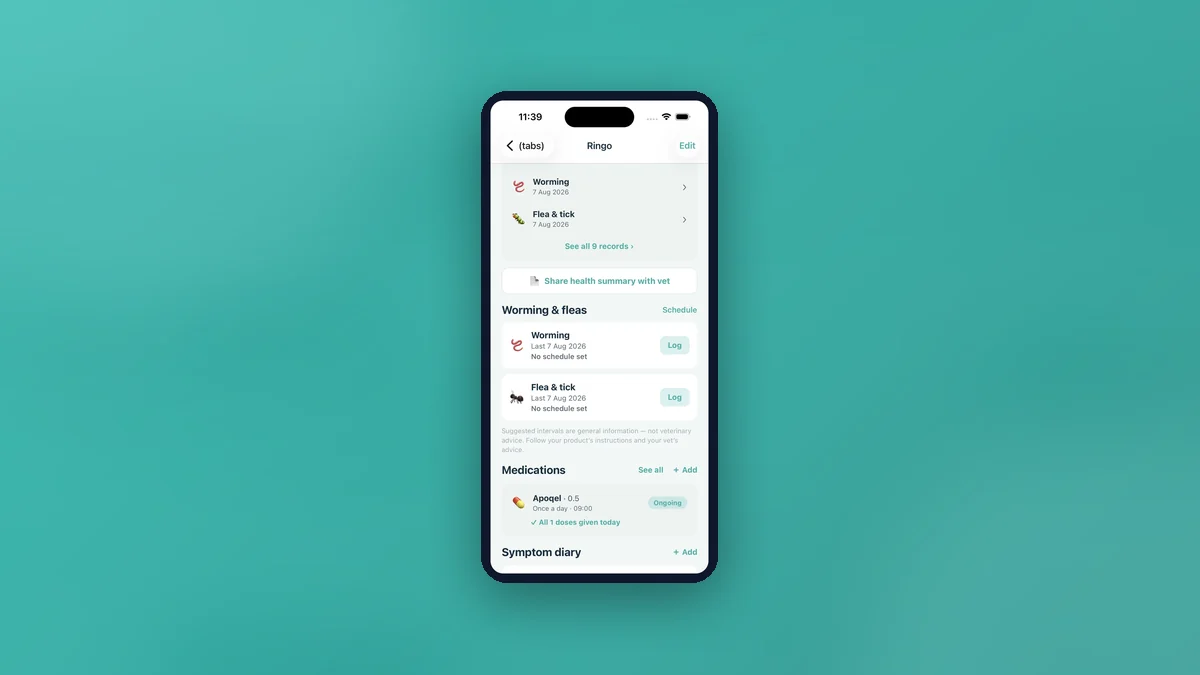
Worming and flea treatment are the records most likely to go missing, because they happen at home rather than at the vet, and nobody hands you a card. Six months later the honest answer to "when was she last done?" is a shrug, and the honest answer to "with what?" is worse.
Why the product name matters
Parasite treatments are not interchangeable. Different products cover different parasites, work over different periods, and come in spot-on, tablet and collar forms. "Flea treatment" is not a useful record; the product name is.
It matters practically too. If you switch products, a vet needs to know what was used and when to advise on timing. If a treatment appears not to have worked, the product and date are the first two questions. And if you buy from more than one place over a year, the only person tracking continuity is you.
What to record each time
- Date given
- Product name, exactly
- Batch or lot number where the packaging shows one
- Weight on the day, since many products are dosed by weight band
- Who gave it
- Anything you noticed afterwards
The weight one is easy to skip and worth keeping. Dogs in particular move between weight bands, and a growing dog can outgrow a dose within a treatment cycle.
Where it lives in CorePaw
Worming and flea/tick are their own record types in health records, alongside vaccinations, vet visits, medications and other. Each record carries the date, product, batch or lot, vet, weight on the day and notes. The full history screen filters by type with per-type counts and groups entries under year headings, so "when was the last worming?" is a two-tap question.
Where a record has a next-due date, it surfaces in the due strip at the top of the health panel and schedules a reminder a week ahead and again on the day, both at 09:00, firing with the app closed.
A note on intervals
CorePaw shows suggested intervals as general information and says so on screen — it does not tell you what your animal needs. Treatment frequency depends on the product, the animal and its actual risk, including whether a cat goes outside and whether the household has other animals. Follow the product's instructions and your vet's advice.
That is also why recording whether a cat goes outside is more useful than it looks — it is one of the inputs to that conversation.
The household version of the problem
In a house where two people might do it, the classic failure is either both doing it or neither. Every CorePaw entry is stamped with who logged it, which removes the ambiguity entirely, and the daily log groups by day so the sequence is visible.
If you have several animals, treating one and being interrupted before the others is common enough to be worth guarding against. Per-pet records mean each animal's history is separately correct rather than lumped together.
General information about record-keeping, not veterinary advice. Parasite treatment choices and intervals belong with your vet and the product's instructions.
Related articles
Keep your pet's whole record in CorePaw.
Passport, microchip, vaccinations, medications, walks and weight — working offline and shared with your household. Free for your first pet, on iPhone and Android.