Has the Dog Had His Tablet? Ending the Guess
Two people, one dose, and no way to check. Why a shared dose log matters more than a reminder, and what "given 13:04 - Tony" actually prevents.
By Tony Dalton · Updated
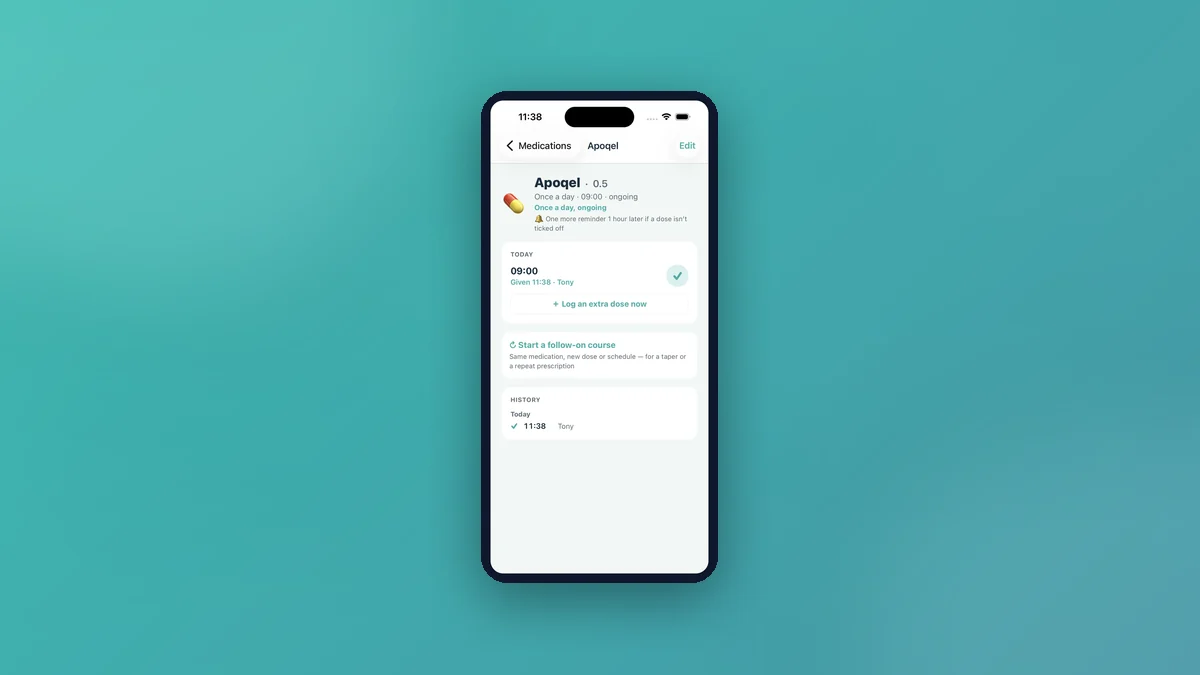
The dangerous failure in household medication is not forgetting. It is two people each assuming the other has not done it. A reminder solves forgetting; only a shared record solves double-dosing, and the second problem is the one with consequences.
Why this happens to organised people
Medication lives in the gaps between routines. One person leaves early, another gets home late, a third is doing the school run. Everyone knows the tablet is due. Nobody knows whether it has happened, because there is nothing to look at — just a blister pack whose count nobody has been tracking and a memory of possibly having done this yesterday.
Asking is unreliable too. "Did you give him his tablet?" gets answered from the same fallible memory that caused the problem, often while someone is doing something else.
What a dose log changes
CorePaw logs each dose as it is given, stamped with who and when — "Given 13:04 · Tony". The medication screen carries a today's-doses checklist plus history, and the pet screen offers a one-tap Give when a dose is due. Off-schedule extra doses can be logged too, because pretending they do not happen makes the record less useful, not more.
The effect is that the question stops being asked. Anybody in the household with medication access can look, and the answer is on the screen with a name and a time against it.
Reminders that actually fire
Underneath, CorePaw schedules OS-level local notifications that fire when the app is not open and survive a phone reboot. They are rebuilt from the database on launch, on foreground and after any medication edit, and permission is only requested when there is genuinely something to remind about.
A medication reminder carries a Mark as given action: tapping it opens the app, logs that dose and clears the notification. That matters because the gap between being reminded and recording it is where the record usually breaks.
Telling the rest of the household
When one person gives a dose, others with medication access are told — "Tony gave Ringo's Apoquel at 14:32". That arrives live while the app is open and as a real push when it is closed, on both iOS and Android. The point is that the information reaches the other person before they act, not after.
Adding people to a household with roles and permissions is part of CorePaw Cloud; see family sharing for how Viewer, Member and Co-owner differ and how per-area permissions are enforced in the database.
Setting a course up properly
A medication course holds the name, dose, frequency of one to four times a day with editable dose times, a start date, and either an ongoing course or a fixed end date with 7, 14 and 28-day quick-sets. Finished courses drop off the pet screen automatically, which is a small thing that keeps the screen honest.
Current medications also appear on the vet health summary PDF, so the answer to "what is he on at the moment?" does not depend on anyone remembering the name of it.
General information about recording medication, not veterinary advice. Doses and schedules are your vet's decision — and if you think a pet has had a double dose, ring your practice.
Related articles
Keep your pet's whole record in CorePaw.
Passport, microchip, vaccinations, medications, walks and weight — working offline and shared with your household. Free for your first pet, on iPhone and Android.