Medication Reminders That Survive Real Life
Phone alarms fail for medication in specific, predictable ways. What a reminder needs to do to still be working in week three of a course.
By Tony Dalton · Updated
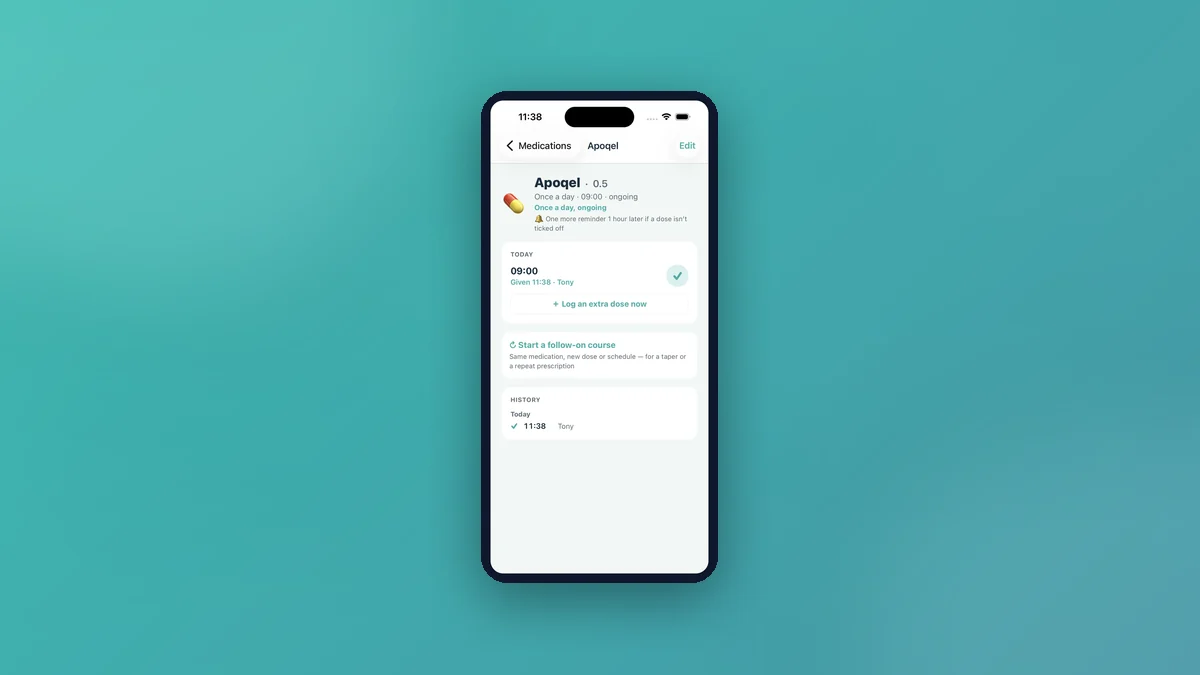
A phone alarm reminds you at a moment. Medication needs something else: a reminder you can act on, a record that it was acted on, and both surviving a reboot, a dead battery and the app never being opened. Most homemade systems fail on the second point, and the failure is invisible until it matters.
How the usual approaches break
- A phone alarm goes off while you are driving. You dismiss it, intend to do it in ten minutes, and the alarm is now gone with no trace of whether it happened.
- A calendar entry is worse — silently marked done by nobody, and invisible to the other person in the house.
- A note on the fridge works only for whoever is standing at the fridge, and never records a time.
- Remembering works for about four days.
The common thread is that reminding and recording are treated as separate jobs, when the gap between them is exactly where doses get lost.
What CorePaw's reminder engine does
Courses schedule OS-level local notifications that fire even when the app is not open and survive a reboot. They are rebuilt from the database on launch, on foreground and after any health or medication edit, so editing a course does not leave stale reminders behind. Notification permission is only requested when there is actually something to remind about.
Ongoing courses use daily-repeating reminders, one per dose time. Fixed courses schedule their individual doses ahead. Vaccination and other due dates get their own treatment: a heads-up a week before and a nudge on the day, both at 09:00.
The bit that closes the loop
A medication reminder carries a Mark as given action. Tapping it opens the app, logs that dose and clears the notification. That single interaction is what stops the reminder-to-record gap from existing, and it is why the dose log stays accurate in week three rather than quietly rotting.
Each dose is stamped with who and when. There is a today's-doses checklist with history on the medication screen, a one-tap Give on the pet screen when a dose is due, and the ability to log an off-schedule extra dose.
Setting a course up
A course holds name, dose, frequency of one to four times a day with editable dose times, a start date, and either ongoing or a fixed end date with 7, 14 and 28-day quick-sets. You can stop a course early or delete it, and finished courses drop off the pet screen on their own.
Editable dose times matter more than they sound. A twice-daily medication given at 08:00 and 20:00 in one household and 07:00 and 19:00 in another is not a preference — it is what makes the reminder land at a time the person is actually available.
Households
When one member gives a dose, others with medication access are told as it happens — live while the app is open, and as a real push when it is closed, on both platforms. That is the difference between a reminder system for one person and one for a household. See why the dose log matters more than the reminder.
General information about reminders and record-keeping, not veterinary advice. Doses and schedules are set by your vet.
Related articles
Keep your pet's whole record in CorePaw.
Passport, microchip, vaccinations, medications, walks and weight — working offline and shared with your household. Free for your first pet, on iPhone and Android.