Pet Insurance Claims: The Paperwork Problem
Claims are slowed by missing history far more often than by disputed cover. What to keep, where to keep it, and what to do before you need it.
By Tony Dalton · Updated
Most claim friction is administrative rather than adversarial: an insurer needs the clinical history, the practice needs to send it, and the owner is in the middle without a copy of anything. Keeping your own organised record does not change what is covered, but it reliably makes the process shorter.
What tends to be asked for
Policies differ and your insurer's own requirements are the ones that count, but claims commonly involve some combination of:
- The policy number and cover dates
- The clinical history from the treating practice, sometimes going back years
- Itemised invoices and receipts
- Evidence of when symptoms were first noticed
- Vaccination history, where a policy has conditions attached to it
- Details of any previous practices the animal was registered with
The last two are where delays come from. If a pet has moved practice, the insurer may want records from both, and you are the only person who knows the second one exists.
Pre-existing conditions and the date question
The single most consequential fact in many claims is when a problem was first noticed. Insurers ask, practices check their notes, and owners guess. If you have recorded the date you first saw something — with a photo — you are in a much stronger position than if you are reconstructing it under pressure.
CorePaw's symptom diary records a start date and builds a dated photo timeline. That is not a legal document, but it is a contemporaneous record, and it is considerably better than nothing.
Keeping the paperwork somewhere it survives
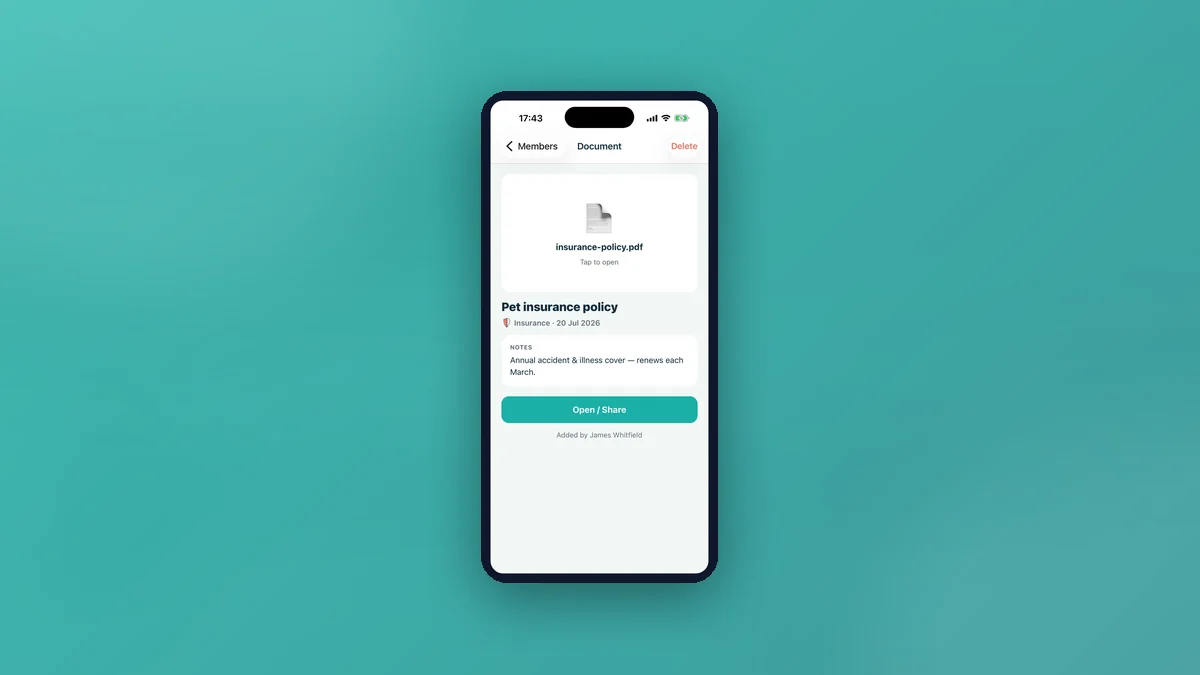
The documents vault files a pet's paperwork by category with an optional date and notes — insurance policies, vet letters, receipts, pedigree and KC certificates, adoption and ownership papers. You can photograph something with the camera, pick an image from the library, or attach a PDF from the device.
Worth understanding how storage works: on the free tier the details sync but the file itself stays on the device that added it. With CorePaw Cloud the file uploads to private storage so every co-parent can open it. If two people in a household need to reach the insurance document, that difference matters.
The policy details themselves
The digital passport carries the insurance provider, policy number and renewal date alongside identity, microchip and vet practice details. Having the renewal date somewhere you will see it is worth more than it sounds — lapsed cover between renewals is a bad way to discover a gap.
Before you need it
Three things worth doing on a quiet evening rather than during an emergency: photograph the policy schedule into the vault, check the renewal date is right, and make sure someone other than you can reach both. The vet health summary PDF covers the clinical side in one tap when a claim starts.
General information about record-keeping, not insurance or veterinary advice. Your policy terms and your insurer's requirements are what govern any claim.
Related articles
Keep your pet's whole record in CorePaw.
Passport, microchip, vaccinations, medications, walks and weight — working offline and shared with your household. Free for your first pet, on iPhone and Android.