Keeping a Food Diary for a Dog or Cat
If a vet ever asks what your pet eats, "some dry food and a bit of chicken" is not an answer. What to record, and why portions need defining.
By Tony Dalton · Updated
A food diary is worth keeping for two situations: an elimination or investigation period where a vet needs to know exactly what went in, and an ordinary multi-person household where nobody is quite sure how much the animal is actually being fed. The second is far more common and causes more problems.
The "a scoop" problem
Ask three people in a household how much they feed the dog and you will get three answers that all sound like the same answer. A scoop, a handful, "the normal amount". Nobody is being careless; there is simply no shared definition, and the difference between two people's scoops over a month is substantial.
Add treats — which almost nobody counts — plus the fact that a dog who looks hungry is very persuasive, and the gap between intended and actual intake gets wide. This is usually the real story behind a weight change that "makes no sense".
What to record
- What. Brand and product, not just "dry food". Brands change formulation.
- Form. Dry, wet, raw, homemade or treat.
- How much, in a unit everyone uses the same way.
- When, and by whom.
- Treats and extras, including what came off the table.
- Anything refused, which is often the first sign something is off.
How CorePaw structures it
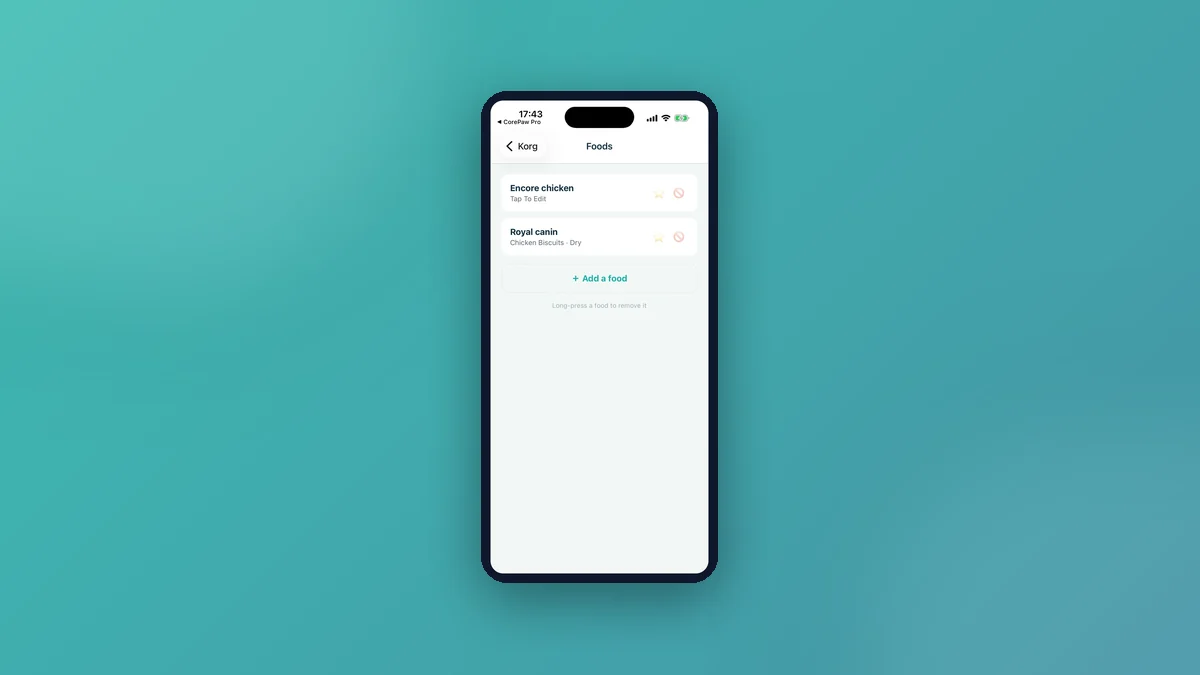
The food library is per-pet, with brand, form, an optional kcal per 100g and a default portion in grams, millilitres, cups, scoops or meals. Once a food is saved with its portion, logging a feed references that food rather than describing it again — which is what makes the record consistent between people.
Foods can be flagged as a favourite or as an avoid. The avoid flag is the one that earns its keep: a sitter, a relative or a teenager can see at a glance what not to give, without anyone having to remember to mention it.
Day to day, feeds are logged from the daily care log — one-tap tiles for feed, water, med, toilet and note — and every entry records who logged it and when, grouped by day.
Allergies are separate, and deliberately so
An avoid flag is a preference or a household rule. A genuine allergy or intolerance is safety-critical, and CorePaw records those separately with the reaction and a mild or severe rating, sitting directly under the passport with severe ones flagged in red. They also appear prominently in the vet health summary PDF.
Keeping the two apart matters: "he doesn't like this" and "this makes her ill" should not look the same on a screen.
For an investigation period
If your vet has asked you to track food for a period, the useful discipline is logging at the time rather than reconstructing at the end of the day, and making sure everyone in the house logs — a single unrecorded treat can undermine a fortnight of careful work. The attribution on each entry is what tells you whether that is actually happening.
General information about record-keeping, not veterinary or nutritional advice. Diet decisions belong with your vet.
Related articles
Keep your pet's whole record in CorePaw.
Passport, microchip, vaccinations, medications, walks and weight — working offline and shared with your household. Free for your first pet, on iPhone and Android.